During 2024 and 2025 and with support from the Missouri Soybean Merchandising Council, we surveyed 18 soybean fields across 7 West Central Missouri counties (Bates, Cass, Henry, Jackson, Johnson, Lafayette, and Vernon) to better understand which plant-parasitic nematodes are present and at what population levels.
Nematodes are common, but presence does not always mean damage
Six types (or taxa) of plant-parasitic nematodes were detected in the region. Spiral and root-lesion nematodes were found in 100% of fields, while soybean cyst nematode (SCN) was detected in 72%. Stunt, lance, and dagger nematodes were detected less frequently (Figure 1). Finding a nematode does not necessarily mean it is causing yield loss. Risk depends on the nematode, population density, crop, and field conditions.
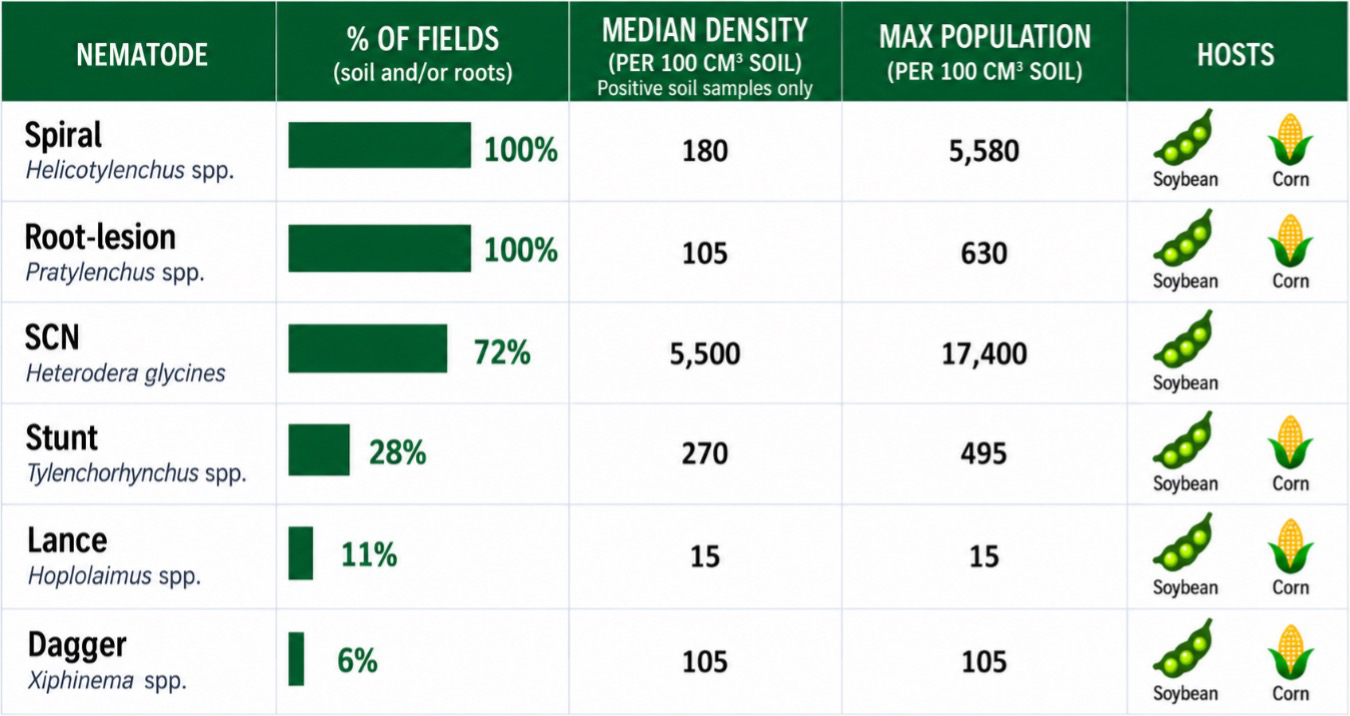
Figure 1 Prevalence (% of fields with detection) and population densities of plant-parasitic nematodes detected in 18 soybean fields across 7 counties in West Central Missouri. Median and maximum population densities are based on positive soil samples only and are reported per 100 cm³ of soil. In the host column, icons indicate the nematode's potential to feed on soybean and/or corn. Host status may vary among nematode species within each group.
Spiral and root-lesion nematodes were detected in every West Central Missouri field surveyed, showing how widespread these nematodes were in the region. SCN was detected less frequently, in 72% of fields, but reached high population densities where present, with a median of 5,500 eggs/100 cm³ soil and a maximum of 17,400.
SCN reproduction differs among resistance sources
We also tested how well these SCN populations reproduce on common sources of SCN resistance. Among the West Central Missouri SCN populations tested, for every 100 females that developed on a susceptible soybean, a median of 55 females developed on PI 88788 (the most common SCN resistance source found in Missouri soybean). On Peking, the median was much lower with 3 females per 100 on susceptible soybean. The higher reproduction on PI 88788 reinforces the importance of knowing and rotating with non-host crops and soybean with other SCN-resistance sources.
What could this mean for yield?
Using representative West Central Missouri conditions and the SCN Coalition Profit Checker, the estimated potential yield loss was 8.3%, or 3.7 bu/acre and $49/acre. Actual estimates depend on SCN population density, virulence (ability to reproduce on the soybean), field conditions, expected yield, and soybean price.
Don't rely on symptoms alone
Nematode problems can be easy to miss. A field with SCN can look healthy while yield is being lost. Stunting, yellowing, uneven growth, and poorly performing areas can indicate a significant problem; however, those symptoms are not specific to only nematodes.
Management starts with knowing what is in the field. For SCN, use resistant varieties, rotate resistance sources such as PI 88788 and Peking, and rotate with a nonhost crop such as corn. Nematode-protectant seed treatments may also provide early-season protection. Management options for other nematodes depend on the species and population density, and resistant varieties are not available for many of them.
Don't guess. Sample. Missouri soybean growers can currently submit up to four soil samples for free SCN egg counts through SCN Diagnostics, supported by the Missouri Soybean Merchandising Council. Visit SCN Diagnostics for more information.